The RRUFF project contains a large collection of oriented Raman spectra collected from well-characterized mineral specimens. These data provide information about how the Raman spectrum changes with the orientation of a crystal relative to the polarization of the incident laser light.
Understanding the geometry of Raman data collected on oriented samples
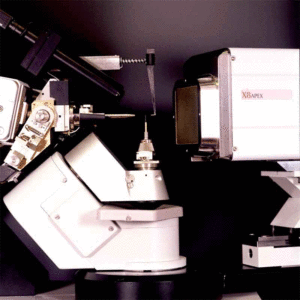
Crystals are examined on a single crystal diffractometer to obtain an orientation matrix that defines their orientation on a goniometer head.
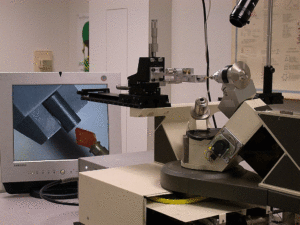
The crystal on the goniometer head is mounted on a modified diffractometer stage and, using the orientation matrix, the crystal is then oriented and glued on a pin relative to two directions.
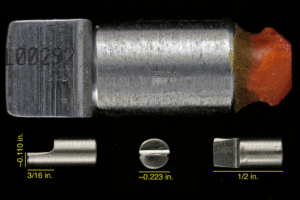
The metal pin is designed with two orientations, 1) the axis of the pin, and 2) a perpendicular direction defined by a flat surface on the pin.
The Laser Direction on RRUFF samples is parallel to the axis of the pin
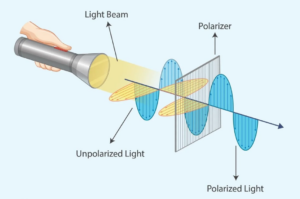
The Laser Polarization Direction on RRUFF samples is perpendicular to the flat surface of the pin.
In many cases, the RRUFF samples are rotated around the pin axis direction to provide a Raman spectra in a different direction of polarization. The angle of rotation is defined by Rotation angle from fiducial mark, where the fiducial mark is the position at rotation angle = 0, in the clockwise or counter-clockwise directions defined by Rotation Angle Direction
In many cases, the RRUFF samples are continuously rotated around the pin axis direction while collecting the Raman spectra in order to provide spectra that are depolarized. These spectra are indicted by a value of depolarized in the Rotation Angle Direction field and a value of 0 in the Rotation angle from fiducial mark field.